


Understanding compressor types and how they are selected
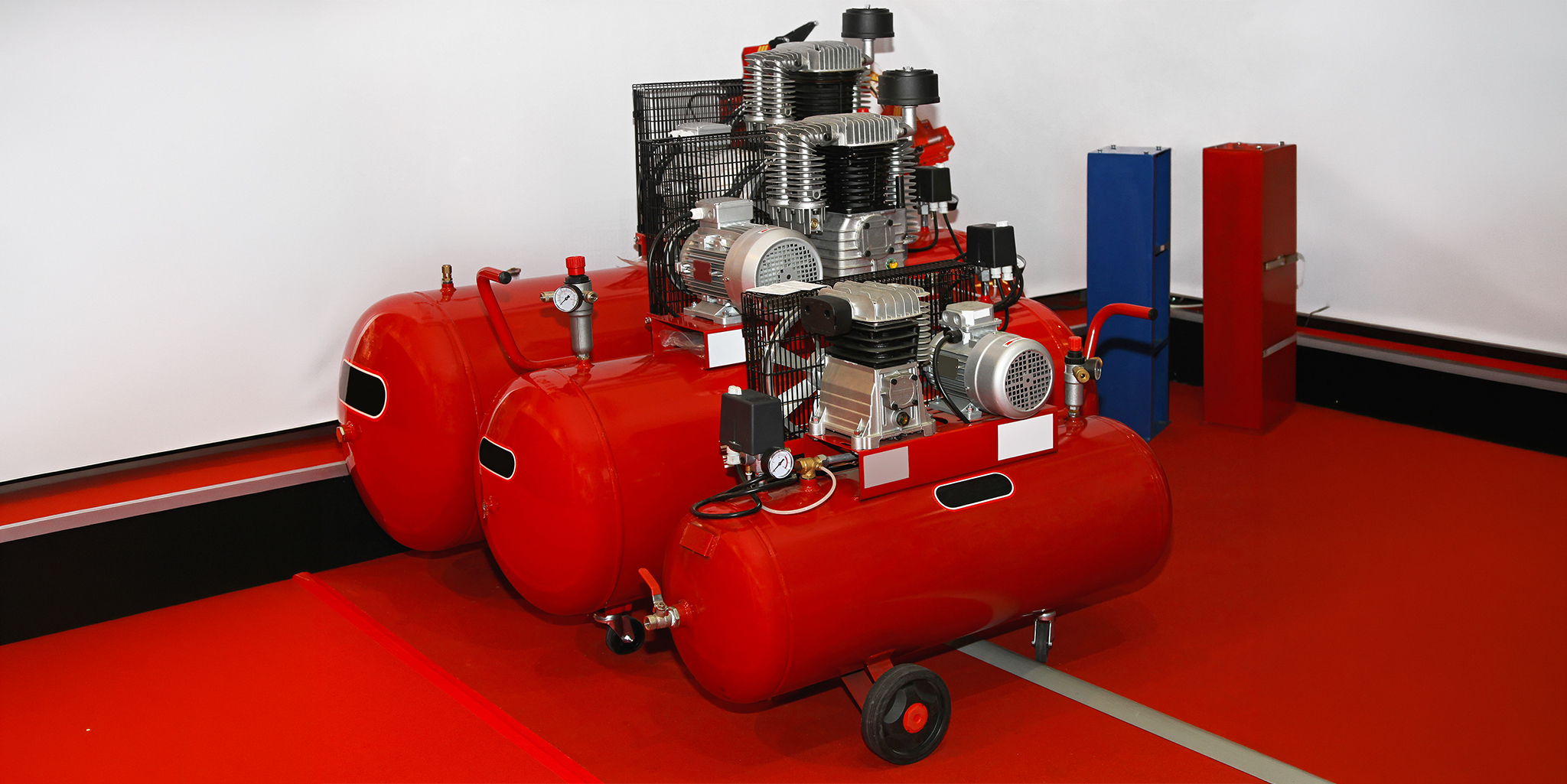
Compressors are machines that increase the pressure of gases. They are widely used in refineries, chemical plants, petrochemical complexes and carbon capture facilities. While they often remain hidden within a plant, they play an essential role in keeping operations running reliably and efficiently.
Because compressors are expensive and consume significant amounts of power, selecting the right type early in a project is critical. An unsuitable choice can result in higher operating costs, increased maintenance requirements and frequent shutdowns. To avoid these challenges, industries follow established engineering practices when determining the most appropriate compressor for a particular application.
Types of Compressors
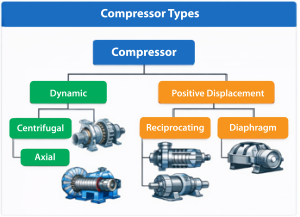
All compressors fall into two broad categories, based on how they increase gas pressure.
a. Dynamic Compressors
Dynamic compressors increase gas pressure by first accelerating the gas to a high velocity and then slowing it down within the machine. As the velocity decreases, pressure increases.
These compressors offer several advantages:
- Smooth and continuous operation
- Suitability for large gas volumes
- Extensive use in large industrial facilities
Common examples include centrifugal and axial compressors.
b. Positive Displacement Compressors+
Positive displacement compressors work by trapping a fixed volume of gas within a chamber and compressing it to a higher pressure.
These compressors are particularly suitable when:
- High discharge pressures are required
- A wide range of gases must be handled
- Flow rates are relatively low or operating conditions vary
Examples include reciprocating, screw and diaphragm compressors.
Selecting a Compressor
The objective of compressor selection is to meet process requirements while achieving the lowest overall cost of ownership throughout the plant’s life. This includes both equipment costs and long term energy and utility consumption.
A compressor is rarely a standalone piece of equipment. It is typically supported by several auxiliary systems that are necessary for safe and reliable operation. For this reason, careful evaluation and planning are essential.
The selection process generally follows four key steps.
Step 1: Understand the Process Requirement
Engineers begin by reviewing several important process parameters:
- Gas flow rate
- Inlet and outlet pressures and temperatures
- Gas composition and impurities
- Presence of liquids in the gas stream
- Future capacity expansion requirements
- Corrosive, hazardous or toxic characteristics of the gas
- Material compatibility requirements
Step 2: Identify Suitable Compressor Types
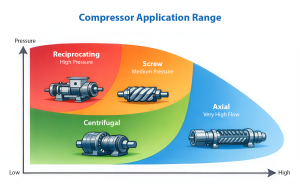
An initial screening is carried out using pressure and flow requirements. Reciprocating or screw compressors are considered where operating conditions are suitable. Centrifugal compressors are generally selected when requirements fall beyond the typical operating range of reciprocating or screw machines.
Step 3: Evaluate Practical Constraints
The technically suitable options are then assessed against practical project considerations, including:
- Availability of drivers such as electric motors or steam turbines
- Space constraints within the plant layout
- Power and utility consumption
- Maintenance requirements and expected uptime
- The need for standby units or turndown capability
Step 4: Optimisation
Once feasible compressor types have been shortlisted, a detailed techno economic assessment is performed to identify the most suitable solution. The objective is to assess the complete life cycle performance rather than focusing solely on the initial purchase cost.
Key optimisation factors include:
Energy Efficiency
Compressors often operate continuously. Even a modest improvement in efficiency can lead to significant savings in annual power costs. Engineers compare isentropic efficiency, polytropic efficiency and expected operating performance across the plant’s operating range.
Life Cycle Cost Assessment
The Total Cost of Ownership (TCO) typically includes:
- Capital cost, including auxiliaries
- Power consumption
- Utility requirements such as cooling water and sealing systems
- Spare parts and maintenance
- Downtime implications
- Reliability and Mean Time Between Failures (MTBF)
Gas Composition and Impurities
Certain gases, including hydrogen rich streams, sour gases and carbon dioxide containing water, can affect compressor performance or damage internal components if unsuitable materials are used. Material selection, sealing arrangements and lubrication systems must therefore be carefully matched to the process conditions.
Control Strategy and Operating Flexibility
Most plants rarely operate at a single design point. Seasonal changes, process fluctuations and capacity variations all influence compressor performance requirements. Appropriate control systems are therefore essential to ensure efficient and flexible operation.
Auxiliary Systems and Overall Complexity
Additional systems such as coolers, filters, knock out drums, lubrication systems, dry gas seal systems and surge control panels contribute to both cost and layout requirements. In most cases, the preferred solution is the one that safely meets the duty with the least overall complexity.
Matching Technology to Project Requirements
The best compressor is not necessarily the largest, newest or most sophisticated option. It is the one that best matches the process requirement while delivering the lowest total cost of ownership throughout the facility’s operating life.
A well selected compressor delivers:
- Stable performance across expected operating conditions
- High reliability with reduced maintenance requirements
- Efficient energy consumption
- Compliance with safety and industry standards
By understanding the process requirements, evaluating suitable technologies and optimising the final selection, engineers can ensure reliable compressor performance for decades.
TCE’s Experience
With more than 50 years of experience in engineering design and commissioning across prestigious industrial projects, TCE has built deep expertise in compressor selection and system design. This experience enables us to address complex challenges and deliver solutions that are reliable, efficient and tailored to each project’s unique requirements.


