


Why Vibration Isolation Matters in Semiconductor Fabs and OSAT Facilities

Semiconductor fabrication plants and Outsourced Semiconductor Assembly and Test (OSAT) facilities are among the most vibration sensitive industrial environments in the world. As chip geometries have moved from microns to single digit nanometres, the margin for disturbance has become extremely small. Even vibrations that people cannot feel can affect tool accuracy, cause overlay errors, create critical dimension variation, lead to misalignment, reduce yield and increase tool downtime.
Unlike conventional manufacturing plants, semiconductor facilities operate with several systems running at the same time. Pumps, chillers, air handling units, vacuum systems, automated material handling systems and even movement of people can create vibration. These vibrations can travel through floors and structures. If vibration isolation is not planned at different levels, it can cross the acceptable limits for sensitive tools.
Why Vibration Control Is So Important
In wafer fabs, vibration can affect some of the most critical processes. Lithography tools, including DUV and EUV systems, can face stage jitter and focus errors, which may result in overlay misalignment. Metrology and inspection tools can lose measurement precision when vibration affects electron or optical beam paths. Etch and deposition processes can also be impacted through changes in film thickness uniformity and process repeatability.
Advanced lithography and metrology tools work at sub nanometre resolution. This makes them highly sensitive to low frequency vibrations, particularly in the 1 to 80 Hz range, when these vibrations are transmitted through the fab floor.
OSAT facilities are usually less sensitive than leading edge fabs, but they still include several vibration critical processes. Wire bonding can be affected through bond placement accuracy and wire loop stability. Flip chip and hybrid bonding depend on stable alignment, coplanarity and interconnect integrity. Wafer thinning, dicing, pick and place activities and high speed test handlers also need mechanical stability to maintain accuracy and throughput.
As OSAT facilities adopt advanced packaging technologies such as 2.5D, 3D integration, system in package and chiplets, their vibration control needs are moving closer to fab level requirements. This is particularly important for hybrid bonding and fine pitch interconnect processes.
Understanding Vibration Criteria
The most widely used benchmarks for semiconductor facility design are Generic Vibration Criterion curves, commonly known as VC curves. These were originally developed by Ungar, Gordon and colleagues, and later formalised through publications and guidelines issued by organisations such as IEST and SPIE. They are now widely used to define acceptable ambient vibration levels in semiconductor fabs, advanced OSAT facilities, nanotechnology laboratories and precision research spaces.
VC curves help designers understand whether the vibration environment of a facility or floor system is suitable for sensitive equipment. They do not prescribe a structural design. Instead, they set vibration limits that can be used as performance targets for floors, slabs and building systems.
These criteria are expressed as root mean square vibration velocity, measured in micrometres per second, across one third octave frequency bands. The usual frequency range is 1 Hz to 80 Hz. This range matters because structural and soil structure resonances often fall within it, most semiconductor tools are more sensitive to low frequency vibration, and tool isolation systems may have limited effect below about 5 to 10 Hz.
By looking at vibration in specific frequency bands, engineers can identify problem areas and plan focused mitigation measures.
VC Levels and Typical Applications
The VC system includes progressively stricter levels, from VCA to VCG. Each higher level means a lower allowable RMS vibration velocity and is linked to greater equipment sensitivity.
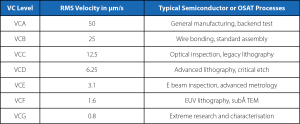
These criteria are used as design targets for floors and buildings. They should not be seen as a guarantee of tool performance, as individual OEM tools may have tighter or frequency specific requirements.
A Layered Approach to Vibration Isolation
Effective vibration control in fabs and OSAT facilities works best when addressed at three levels: tool level, floor level and building level.
Tool Level Isolation
Tool level isolation is the final protection layer for sensitive equipment. It helps protect tools from the floor vibration that remains after facility level measures are in place. Common solutions include passive pneumatic isolators, spring damper systems, active isolation systems using piezoelectric or electromagnetic feedback, and heavy granite or inertia bases.
Advanced tools such as EUV scanners and E beam inspection systems often include active isolation systems that can meet VCE to VCG performance levels, even when floor conditions are not perfect. However, these systems have limits. They cannot fully correct excessive low frequency floor movement, their performance can drop if the floor does not have enough stiffness, and active systems placed above other active systems need careful engineering.
Floor Level Isolation
The cleanroom floor is often the main path through which vibration reaches tools. Semiconductor fabs commonly use thick concrete waffle slabs or cheese slabs, high mass and high stiffness designs, and floor systems with natural frequencies above 8 to 10 Hz.
Slabs on grade generally perform better than elevated slabs. However, many modern fabs use upper-level cleanrooms, which makes structural dynamics an important part of facility design.
Raised Floor Challenges
Fabs and OSAT facilities often use raised access floors to route utilities. These floors are not naturally good vibration performers. Sensitive tools may therefore need pedestals anchored to the structural slab, quiet island or isolated plinth solutions, and localised inertia blocks.
Building Level Isolation
At the building scale, the aim is to stop vibration from entering or travelling through the structure. This includes isolating rotating equipment such as pumps, compressors, chillers and air handling units, using inertia bases and spring isolators, separating subfab and cleanroom structures, and isolating automatic material handling system tracks.
Subfab equipment is often a major source of vibration and should be systematically decoupled from the cleanroom above.
Site and Layout Considerations
Good vibration control starts before the facility is built. Site and layout decisions should consider distance from railways, highways and heavy industry, soil stiffness and damping properties, and zoning of sensitive and less sensitive areas.
For advanced fabs, early site vibration surveys are now standard practice.
Fab and OSAT Vibration Needs at a Glance

Conclusion
Vibration isolation is no longer a secondary design consideration for semiconductor facilities. It directly supports yield, uptime and technology scaling across both wafer fabs and OSAT facilities. As process nodes shrink and packaging technologies advance, vibration performance requirements are becoming stricter across the semiconductor value chain.
Successful facilities address vibration from the beginning. They combine tool level isolation, strong floor design and building wide source control as part of the early design strategy. Facilities that do not plan for vibration control may face expensive retrofits, tool underperformance and long term yield impact.


