


Artificial Intelligence and India’s Sustainable Energy Transition
India’s energy sector is undergoing a rapid transformation as the country moves towards a cleaner, smarter and more resilient power system. Artificial intelligence (AI) is emerging as an important enabler of this shift, supporting coal plant optimisation, renewable energy expansion, predictive maintenance and enhanced safety. As India works towards its net zero target by 2070, AI is helping improve project execution, grid reliability, engineering efficiency and operational decision-making.
Coal-fired power plants have long formed the backbone of India’s electricity system. However, they are increasingly facing challenges linked to environmental performance, ageing infrastructure and operational efficiency. At the same time, the country is accelerating the deployment of renewable energy and integrating it with existing infrastructure. In this changing landscape, AI is playing an important role in supporting both power plant modernisation and the growth of renewable energy.
AI and Digital Transformation in India’s Energy Transition
India’s energy mix is evolving rapidly through the growth of solar, wind, hydro and pumped-storage projects. At the same time, coal-based power plants continue to provide critical baseload support. Balancing these requirements calls for new approaches and modern technologies, as depicted in Figure 1.
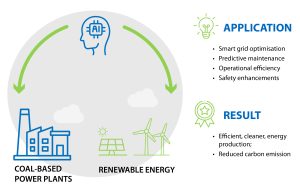
Figure 1: Transformation Era
AI is helping drive this transformation through predictive intelligence, pattern recognition and optimisation across planning, construction and operations. By analysing large volumes of data from sensors, plant systems, environmental sources and engineering models, AI enables faster and more informed decision-making.
- AI for project deployment and site selection
Selecting the right project location is critical to renewable energy performance. AI supports site selection by analysing satellite imagery, climate data, land-use information and terrain models. These insights help developers identify high-yield zones, assess seasonal variations and avoid environmentally sensitive areas. - AI-driven renewable energy design and engineering
AI also improves project execution planning. Optimisation tools support decisions related to material movement, workforce deployment and equipment sequencing. This helps reduce construction delays and cost overruns while making better use of available resources on site.The design of solar, wind and hydro facilities depends on detailed assessments of environmental and geographical conditions. AI strengthens this process through rapid simulations, automated modelling and risk evaluation.AI-driven engineering tools analyse solar irradiation profiles, wind speed dynamics, topography, hydrology and structural load conditions. These simulations allow engineers to compare thousands of design scenarios and choose layouts that maximise energy yield while reducing risk. Automated calculations improve design accuracy, shorten design cycles and support cost-efficient project planning.In solar and wind projects, AI helps optimise panel orientation, turbine placement, cable routing and load distribution. In hydro and pumped-storage projects, AI models assess water flow patterns, sediment behaviour and reservoir characteristics. - AI for coal plant flexibilisation and performance optimisation
Coal-based power plants were originally designed for stable, continuous operations. With higher renewable penetration, these plants must now operate more flexibly, responding to daily demand variations and renewable intermittency. AI helps coal plants achieve this shift in a practical and economical manner.Predictive maintenance algorithms analyse equipment vibrations, thermal variations and sensor readings to detect early signs of equipment degradation. By predicting failures before they occur, AI reduces unplanned outages and extends asset life. Heat-rate optimisation models improve combustion efficiency, optimise boiler and turbine parameters and reduce emissions.AI-based anomaly detection identifies operational deviations in real time. This strengthens equipment protection and reduces safety risks. AI also supports planning by analysing grid requirements, generation patterns and optimum dispatch windows, helping plants operate more efficiently in a renewable-heavy grid environment. - AI-enabled operations and safety management
Once a plant is commissioned, AI strengthens operational reliability and safety. AI-powered monitoring systems analyse data from SCADA systems, IoT sensors, drones and weather feeds to identify performance deviations. Operators receive real-time alerts and recommended corrective actions.Predictive maintenance for renewables, particularly wind turbines, reduces downtime and improves energy yield. AI-based image recognition supports the inspection of solar modules, turbine blades and hydro-mechanical structures. This helps detect cracks, overheating, alignment issues and structural wear.AI improves safety by detecting hazardous conditions, monitoring restricted zones and triggering automated safety responses. Digital dashboards offer leadership teams real-time visibility of plant efficiency, safety indicators and compliance parameters. - Key benefits of AI integration
AI adoption across the energy sector delivers measurable value:
-
- Efficiency improvement: Coal plants using AI-based optimisation have reported 2–3% thermal efficiency gains, reducing fuel consumption and emissions.
- Faster project development: AI-enabled modelling shortens design cycles, reduces engineering rework and lowers capital expenditure overheads.
- Improved reliability: Predictive maintenance reduces failures, improves uptime and strengthens grid stability.
- Enhanced transparency: Digital dashboards and automated reporting support regulatory compliance and build public trust.
- Stronger safety: Real-time hazard detection and automated responses reduce human exposure to risk.
TCE’s implementation
Tata Consulting Engineers (TCE), with its long-standing experience in power plant engineering, is implementing AI-enabled Advanced Process Control (APC) for thermal power plants. The APC model uses data from sensors and design controls for heat-rate optimisation.
The model uses a set of cause-and-effect relationships between controlled, manipulated and feedforward variables to predict controlled variables. The existing set points and bias for the parameters in focus are superimposed with predictive control algorithms. This helps minimise process variations and improve power plant efficiency.
Strategic Importance in Powering India’s Energy Future
AI has an important role to play in advancing India’s energy security and sustainability goals. It improves forecasting accuracy for renewable energy generation, supports demand balancing and strengthens storage system optimisation. As the grid becomes more decentralised, with microgrids, rooftop systems and electric vehicle charging, AI will play an even greater role in stabilising supply.
Predictive intelligence helps utilities manage assets more cost-effectively, reduce lifetime costs and improve financial performance. AI also supports regulatory planning by enabling long-term scenario modelling and policy evaluation.
AI is a key enabler of India’s energy transition. By accelerating renewable energy deployment, improving plant efficiency, supporting flexible operations and strengthening safety, AI ensures that the shift from coal to clean energy is practical, sustainable and future-ready. As India continues to modernise its energy ecosystem, AI-driven intelligence will remain central to building a resilient, efficient and environmentally responsible power sector.
As energy transition technologies continue to evolve, organisations will increasingly need practical ways to integrate AI into planning, engineering and operations. With its experience across conventional and renewable energy projects, TCE is well positioned to help clients apply AI-enabled digital solutions that improve reliability, efficiency and long-term sustainability.


