


Blockchain in Construction: Building Trust, Traceability and Intelligence into the Project Lifecycle

Blockchain technology has emerged as a significant digital innovation with the potential to transform how information and transactions are managed across industries by enabling greater transparency, security and decentralisation. Recognised as a general-purpose technology (GPT), blockchain is increasingly being explored within the architecture, engineering and construction (AEC) sector, where projects typically involve multiple organisations, complex contractual relationships and large volumes of information exchanged throughout the project lifecycle.
In construction, its relevance extends well beyond cryptocurrency. Blockchain offers a different way of recording, verifying and sharing information, with the potential to address persistent industry challenges around fragmented data management, trust, payment delays and regulatory compliance. Its integration with digital tools such as Building Information Modelling (BIM), smart contracts, IoT, AI and digital twins also positions blockchain within the wider transition towards Construction 4.0.
The opportunity, however, is not simply to introduce another digital technology into the construction ecosystem. The more important question is how blockchain can strengthen the connections between information, transactions, contracts and decisions across increasingly digital project environments.
Understanding Blockchain Beyond Cryptocurrency
At its core, blockchain is a distributed digital ledger system that maintains transaction records in a secure sequence of interconnected blocks. Each block contains secured transaction records, a time marker and the cryptographic hash of the preceding block, creating a chain in which information can be verified across the network. Since its introduction alongside Bitcoin in 2008, blockchain has expanded beyond cryptocurrency applications into areas including finance, healthcare, supply chain management and engineering.
Several characteristics distinguish blockchain from conventional approaches to managing digital transactions and records:
- Decentralisation: Reduces reliance on a central authority by distributing information across the network.
- Immutability: Once information has been confirmed, the record remains permanent unless the network collectively agrees to a change.
- Transparency: Participants can view the history recorded on the ledger.
- Security: Cryptographic hashing helps maintain data integrity.
- Programmability: Blockchain can support smart contracts that automate the execution of predefined actions.
Together, these characteristics explain why blockchain is being considered for industries such as construction, where information can move between multiple stakeholders and systems over the life of a project.
How a Blockchain Transaction Moves from Request to Record
A blockchain transaction typically progresses through a series of stages. A user initiates a transaction, which is then validated by participants or nodes within the network. Validated transactions are assembled into a block, and a consensus mechanism is used to validate that block. Once accepted, the block is added to the chain and the participants’ ledgers are updated.
The process can be understood through six broad stages:
- Transaction initiation: A user requests a transaction.
- Verification: Network participants or nodes validate the transaction.
- Block creation: Validated transactions are assembled into a block.
- Consensus: The block is validated according to the network’s agreed protocol.
- Block addition: The validated block is appended to the chain.
- Ledger update: Participants’ ledgers are updated with the new information.
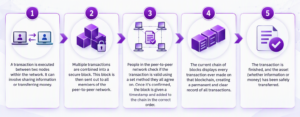
Figure: An overview of the basic process behind a blockchain transaction.
Why Blockchain Has Relevance for Construction
Construction has historically depended heavily on paper-based and traceable documentation. As the sector has become more digital, the volume and speed of information exchange have increased, but information can also become fragmented across multiple participants and systems.
Blockchain provides a potential mechanism for strengthening the way this information is recorded and exchanged. Applications identified for the sector include:
- secure digital property records;
- timestamping actions and transactions;
- multi-signature authorisations for approvals; and
- automated execution through smart contracts.
The value of these applications becomes clearer when viewed within the everyday realities of construction projects, where designers, contractors, suppliers, consultants, clients and other participants may need to rely on a common history of decisions, approvals, information exchanges and contractual actions.
Connecting Blockchain with BIM
Building Information Modelling (BIM) provides an intelligent 3D modelling process for integrated project design, construction and management. While BIM has strengthened collaboration across project environments, digital information exchange also brings questions around data ownership, security and legal accountability.
Blockchain can complement BIM by creating a verifiable record of data exchanges and linking selected transactions with automated processes. Potential applications include:
- tracking BIM data exchanges;
- maintaining immutable records to strengthen legal reliability; and
- integrating BIM with smart contracts to support automated approvals and payments.
One example identified in this area is Bimchain, which is developing blockchain-based BIM solutions intended to connect digital building models with legally binding workflows.
The significance of this integration lies in bringing the digital representation of an asset closer to the contractual and transactional processes surrounding its delivery.
Turning Contract Conditions into Automated Actions
Smart contracts represent another important application of blockchain in construction. These are automated agreements embedded within a blockchain that operate based on predefined rules. Within construction, the approach has potential relevance to long-standing issues including payment delays, dispute resolution and contractual clarity across multiple stakeholders.
By securing funds within the blockchain, smart contracts can help reduce insolvency risks and strengthen trust between contractors and clients. More broadly, linking predetermined contractual conditions to execution creates the potential for certain actions within a project workflow to occur once agreed conditions have been satisfied.
For an industry characterised by complex contractual relationships, this changes the role of blockchain from being simply a system of record to becoming part of the mechanism through which agreed project processes can be executed.
Creating Greater Visibility Across Construction Supply Chains
Construction supply chains involve the movement of materials, information and transactions across numerous organisations. Blockchain offers end-to-end traceability for construction materials, supporting the verification of authenticity, origin and delivery. When integrated with IoT devices, this visibility can be extended further.
The opportunity is significant because supply-chain information can influence procurement, quality, contractual compliance and project delivery. A common, verifiable record can help provide participants with clearer visibility of transactions and material movement across this network.
Measuring Digital Readiness Before Scaling Adoption
Understanding the potential of a technology is only one part of digital transformation. Organisations also need to understand whether their existing capabilities, processes and culture are ready to support adoption.
A maturity model provides a structured way of assessing this readiness and identifying specific gaps and priorities. The Industry 4.0 Maturity Model considered here encompasses 62 assessment factors across nine categories and looks beyond technology alone by incorporating both technological and organisational dimensions.
Key areas within the Industry 4.0 maturity framework
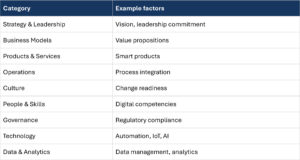
The framework uses a five-level ranking system, ranging from Level 1, where Industry 4.0 features show minimal alignment, through to Level 5, representing a highly advanced level of Industry 4.0 implementation.
Assessment broadly involves three stages:
- Questionnaire: Multiple-choice questions examine the nine categories and are rated from 1, or Not at all developed, to 5, or Fully developed.
- Maturity calculation: Responses are processed to create a score for each category, with potential weighting according to relative importance.
- Report and visualisation: Results are presented in a structured report and may be supported by radar charts for visual interpretation.
This framework can help identify existing capabilities, gaps and priority areas for action. Within those dimensions, blockchain has the potential to contribute in multiple ways, from enabling decentralised and consensus-driven systems to supporting secure information exchange and transparent records across stakeholders. Its compatibility with technologies including IoT, AI and digital twins further connects its development with the broader ambitions of Construction 4.0.
What Industry Applications Tell Us
The practical relevance of blockchain becomes clearer through examples of its application across industries and project environments.
Hitachi adopted Hyperledger Fabric to replace paper-based contracts across more than 3,500 companies, with the implementation reported to reduce fraud risks and operational delays. The TradeLens platform developed by IBM and Maersk, while originally created for shipping logistics, provides another example of blockchain-based supply-chain applications. In the academic sphere, Delft University proposed a blockchain-based Engineering, Procurement and Construction (EPC) supply-chain model for the oil and gas sector that achieved a reported 12.4% cost reduction, alongside improved coordination through the integration of smart contracts and IoT technologies.
The original research also looks at L&T Construction’s digital transformation initiatives, with particular emphasis on smart contracts. Blockchain-based smart contracts have been used to convert traditional clauses into self-executing digital blocks, create tamper-proof records, enable digital signatures for remote participation and provide stakeholders with real-time data access.
The wider digital strategy cited alongside blockchain includes supply-chain tracking of fuel and concrete, sensor-based monitoring of precast and formwork, and drone-based reviews reported to have reduced project monitoring time by 20%. The organisation has also connected machines and projects for real-time monitoring, used VR modules for worker training, implemented RFID and geo-fencing for safety and productivity, and digitised documentation to reduce paper usage.
Taken together, these applications demonstrate potential across three important areas:
- improving procurement efficiency;
- increasing transparency across supply chains; and
- reducing legal and financial risks.
At the same time, adoption barriers remain, including lack of standardisation, scalability concerns and regulatory uncertainty. These limitations are important because the transition from promising use cases to widespread implementation depends on more than technological capability alone.
Moving from Potential to Practical Adoption
Blockchain has the potential to strengthen trust, transparency and efficiency across the construction project lifecycle. Its integration with BIM, smart contracts and supply-chain management systems connects the technology to the wider development of Construction 4.0, while the applications considered here illustrate opportunities to improve procurement efficiency, reduce disputes, secure data management and strengthen collaboration among project stakeholders.
Yet widespread adoption remains at an early stage. Interoperability, regulatory uncertainty, scalability and limited awareness continue to create barriers, which means realising blockchain’s potential will require the sector to move beyond isolated pilots and towards stronger industry-wide standards and policies.
A Practical Path Towards Construction 4.0
The next phase of blockchain adoption will require collaboration between industry stakeholders, policymakers and technology providers. Rather than treating blockchain as an isolated technology implementation, the construction sector needs a structured approach that connects technology adoption with governance, skills, interoperability and wider digital transformation.
Five areas will be particularly important:
- Standardisation and policy frameworks
Clear regulatory guidelines and interoperability standards will be important for strengthening trust and supporting wider adoption. - Pilot projects and demonstrations
Successful pilot initiatives need to be scaled to demonstrate blockchain’s practical value in real project environments. - Integration with emerging technologies
Connections with IoT, AI and digital twins can help unlock wider Construction 4.0 capabilities rather than allowing blockchain to operate as an isolated digital layer. - Capacity building
Professionals need the skills and awareness required to understand the technology, overcome resistance to change and close existing knowledge gaps. - Scalability and cost optimisation
Continued research is required to improve transaction speed, reduce costs and ensure that blockchain platforms can support large-scale construction projects.
From Digital Technology to a Trusted Project Ecosystem
Blockchain should therefore not be viewed as a standalone answer to the construction industry’s challenges. Its greater value lies in its role as a strategic enabler within the industry’s broader digital transformation.
As BIM, IoT, AI, digital twins and other digital technologies become more closely embedded in the project lifecycle, the ability to establish trusted records, trace transactions and connect information with contractual processes becomes increasingly relevant. By addressing the barriers to adoption and following a more structured roadmap, the construction sector can use blockchain to support a more transparent, collaborative and efficient project ecosystem


