


Engineering Corridors of Growth: The Next Leap in India’s Infrastructure Journey
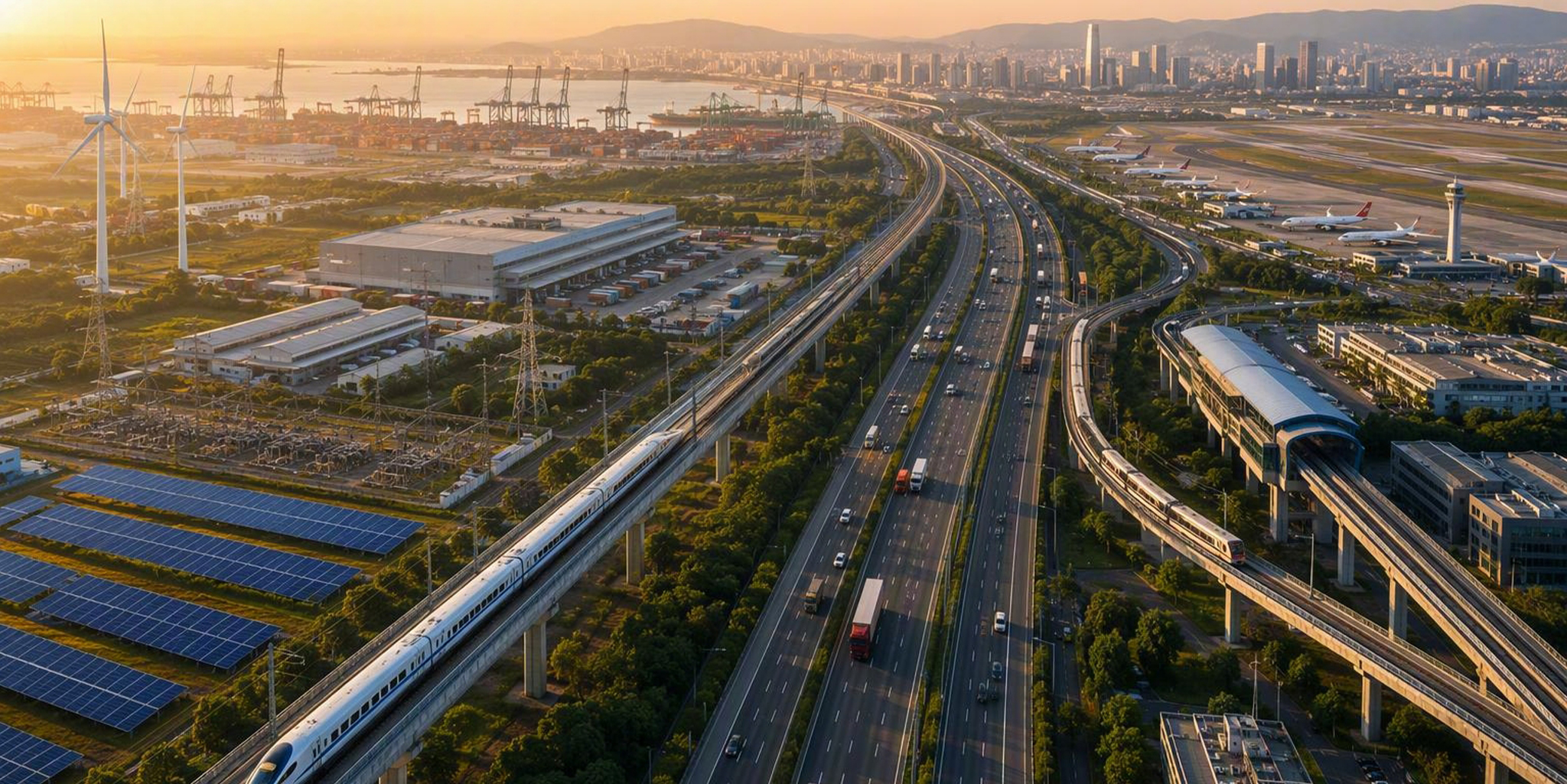
India’s infrastructure journey is entering a decisive and exciting phase. As the country expands its highways, railway networks, metros, freight corridors, ports and waterways, the next leap will come from making these investments work together to create greater economic, social and environmental value. The focus must now move beyond the number of kilometres constructed or the time saved between two destinations to the wider transformation that infrastructure can enable across an entire region.
A road can reduce travel time, a railway can move freight efficiently, and a bridge can overcome a physical barrier. However, when these assets are planned independently, their impact may remain limited to the immediate problem they were designed to solve. Corridor-led development begins with a much broader question: what economic and social possibilities can this infrastructure unlock? This approach treats transport, industry, logistics, urban development, utilities, communities and natural systems as interconnected parts of one regional economy. For a country of India’s scale and ambition, corridor-led development is not merely an alternative planning model. It is a powerful means of multiplying the value of infrastructure investment.
From transport alignment to regional development
A conventional transport project generally begins with an alignment, while a corridor-led development plan begins with an understanding of the region. It examines where people live, where jobs can be created, how goods and people will move, what industries can grow and how towns along the alignment are likely to evolve. It considers the location of industrial clusters, logistics parks, warehouses, urban centres and social infrastructure, together with the supporting requirements for power, water, digital connectivity, waste management and public transport. Most importantly, it addresses these questions before individual projects are designed and contracts are awarded.
Early integration can substantially improve capital and operating efficiency. Common infrastructure can serve multiple developments, utilities can be planned in advance instead of being added through repeated excavation and modification, and land can be reserved for future expansion. Interchanges, stations and logistics facilities can be located according to economic demand rather than treated as isolated engineering components. This is the essential difference between delivering a transport asset and developing a corridor. An individual project creates connectivity, while a well-planned corridor builds an ecosystem around that connectivity.
India’s Dedicated Freight Corridors demonstrate the potential of this approach. Their value extends beyond enabling faster and more reliable freight movement. They can influence the location of manufacturing facilities, logistics hubs, warehouses and distribution centres, while releasing capacity on conventional railway networks for passenger services. Regional rapid transit systems can create a similar multiplier effect. When integrated with transit-oriented development, multimodal connections and dependable last-mile mobility, they can expand access to employment, support the growth of surrounding towns and reduce pressure on congested metropolitan centres. Expressways, industrial corridors and inland waterways can also catalyse investment across their wider influence areas when the supporting infrastructure is planned as part of the same development vision.
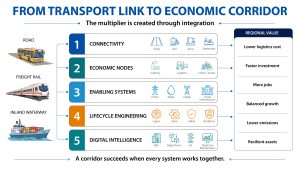
Engineering the corridor as one system
The performance of a corridor is determined by how effectively its individual components work together. An industrial zone connected by an expressway but lacking dependable power and water will struggle to attract investment. A freight terminal without efficient first and last-mile connectivity can become a new bottleneck. A transit station surrounded by unplanned development may not achieve its expected ridership or urban value. Similarly, an advanced infrastructure asset that is difficult or expensive to maintain may become a long-term financial burden. In an interconnected corridor, the weakest interface can constrain the performance of the entire system.
This makes coordination across institutions as important as coordination across engineering disciplines. Infrastructure authorities, urban local bodies, industrial development organisations, utility providers and planning agencies need to work from a shared regional vision. Land use, mobility, industrial demand, environmental capacity and utility planning must be based on compatible assumptions. Engineering consultants have an important role in bringing these elements together and translating the development vision into coordinated, technically sound and implementable projects.
The objective must also extend beyond achieving the lowest initial capital cost. Decisions made during planning and design determine how an asset will perform for several decades. The choice of alignment, structural system, materials, drainage, inspection access and equipment affects safety, energy consumption, maintenance frequency and service continuity. The most economical solution is therefore not necessarily the one with the lowest construction cost, but the one that creates the highest value across the asset lifecycle. Capital and operating expenditure must be evaluated together, with due consideration for maintainability, adaptability and future expansion.
This lifecycle perspective becomes particularly important in corridor development because the failure of one component can disrupt the wider network. A flooded underpass, unavailable tunnel, damaged bridge or failed utility connection can affect mobility, industrial production and supply chains far beyond its immediate location. Resilience must therefore be designed into the corridor from the beginning rather than added later as a corrective measure.
Building resilience into infrastructure
Infrastructure being built today will operate in climatic conditions that may be very different from those experienced in the past. Historical data remains an important engineering input, but it may not fully represent the intensity and frequency of future rainfall, flooding, extreme heat, landslides and other events. Projects need to be designed not only for compliance with present requirements but also for performance under changing conditions.
For bridges, this may require a deeper understanding of river behaviour, scour, flood levels, seismic forces and wind conditions. Tunnel projects must address uncertain geology, groundwater pressure, ventilation, emergency access and the protection of surrounding structures. Roads and railway systems must account for drainage capacity, slope stability, heat-related deterioration and the continuity of critical services. These are not isolated design considerations. Across an economic corridor, they represent interconnected risks with potential consequences for people, businesses and supply chains.
Climate resilience must consequently influence route selection, structural design, drainage, material selection, asset protection and emergency planning. Nature-based measures can complement conventional engineering solutions where appropriate, while environmental and social considerations must be integrated early when meaningful alternatives are still available. The cost of incorporating resilience is visible during project development, but the far greater cost of its absence can recur throughout the life of the asset.
Transforming the construction ecosystem
The scale and complexity of corridor development will also change what is expected from contractors, equipment manufacturers and technology providers. Faster delivery schedules, difficult terrain and stringent requirements for quality and safety are accelerating mechanisation across construction. Contractors will require modern equipment fleets, dependable workshops, access to spare parts and robust preventive maintenance capabilities. They will also need mobile teams of skilled operators, technicians, surveyors, safety professionals and digital coordinators who can work across geographically dispersed project packages.
Investment in equipment must be supported by an equally strong investment in people. The productivity and safety advantages of mechanisation depend on the capabilities of those operating and maintaining the machines. Conditions at construction camps will also become increasingly important. Safe accommodation, sanitation, healthcare, training and worker welfare directly influence productivity, workforce retention, safety and construction quality, and should be treated as project delivery capabilities rather than peripheral compliance requirements.
Modern construction is also becoming increasingly capital-intensive, which may require contractors to consider equipment leasing, fleet-sharing arrangements, specialised subcontracting and stronger partnerships with manufacturers. Equipment companies, in turn, will need to develop machines that are reliable, safe, maintainable and suited to Indian geological, climatic and operating conditions. Lower maintenance requirements, dependable after-sales support and lifecycle cost will be as important as initial performance. The construction ecosystem of the future will be built on specialised capabilities and collaboration across contractors, manufacturers and technology companies.
Turning project data into engineering intelligence
Digital technologies are beginning to transform how complex infrastructure is planned, delivered and maintained. Building Information Modelling can bring engineering disciplines onto a shared platform, resolve conflicts before construction and improve coordination among multiple organisations. Four-dimensional modelling can connect the design with construction schedules, while common data environments can improve document control, visibility and accountability across the project lifecycle.
More advanced applications can add intelligence to construction operations. Smart tunnel boring machines can use actual underground information to optimise torque, thrust and advance rates as ground conditions change. Drones, LiDAR and machine vision can support surveys, monitor physical progress and identify deviations. Automation and robotics can reduce human exposure to confined spaces, heights, hazardous environments and repetitive work. These technologies can improve safety and productivity, but their adoption must remain guided by the practical requirements of the project rather than by technology for its own sake.
For completed assets, sensors and Internet of Things platforms can continuously monitor strain, vibration, displacement, corrosion, temperature and other indicators of structural performance. Digital twins can connect this information with engineering models, inspection findings and maintenance records. Artificial intelligence can then help identify patterns and provide early warning of deterioration, supporting a shift from periodic inspection and reactive repair to continuous awareness and predictive intervention.
Technology cannot, however, compensate for fragmented processes or poor-quality data. Its successful application requires clearly defined information standards, interoperable systems, cybersecurity safeguards and professionals who understand both engineering and digital tools. The objective is not to digitise every activity, but to make every important engineering and operational decision better informed.
Measuring the value that infrastructure unlocks
The success of a corridor cannot be measured only by the length of infrastructure delivered, the speed of construction or the time saved between its endpoints. Its more meaningful outcomes lie in lower logistics costs, improved supply-chain reliability, increased investment, employment generation, safer mobility, stronger local economies and improved access to markets and essential services. Environmental performance and the ability to withstand disruption must also form part of this assessment.
Achieving these outcomes requires a shift from project completion to long-term value creation. Engineering consultants, planners, contractors, technology providers, public authorities and communities must work together from the earliest stages, with shared visibility of the outcomes the corridor is expected to deliver. Infrastructure should not be viewed as an end in itself, but as a platform that enables economic activity, connects communities and strengthens regional resilience.
India’s next infrastructure leap will come from connecting more than destinations. It will come from connecting transport with industry, cities with employment, investment with enabling infrastructure and economic growth with environmental responsibility. A road carries vehicles and a railway carries passengers and freight, but a corridor, when planned and engineered as an integrated system, carries the development potential of an entire region. That is the infrastructure multiplier India must now pursue.


