


Engineering Infrastructure for the Age of AI
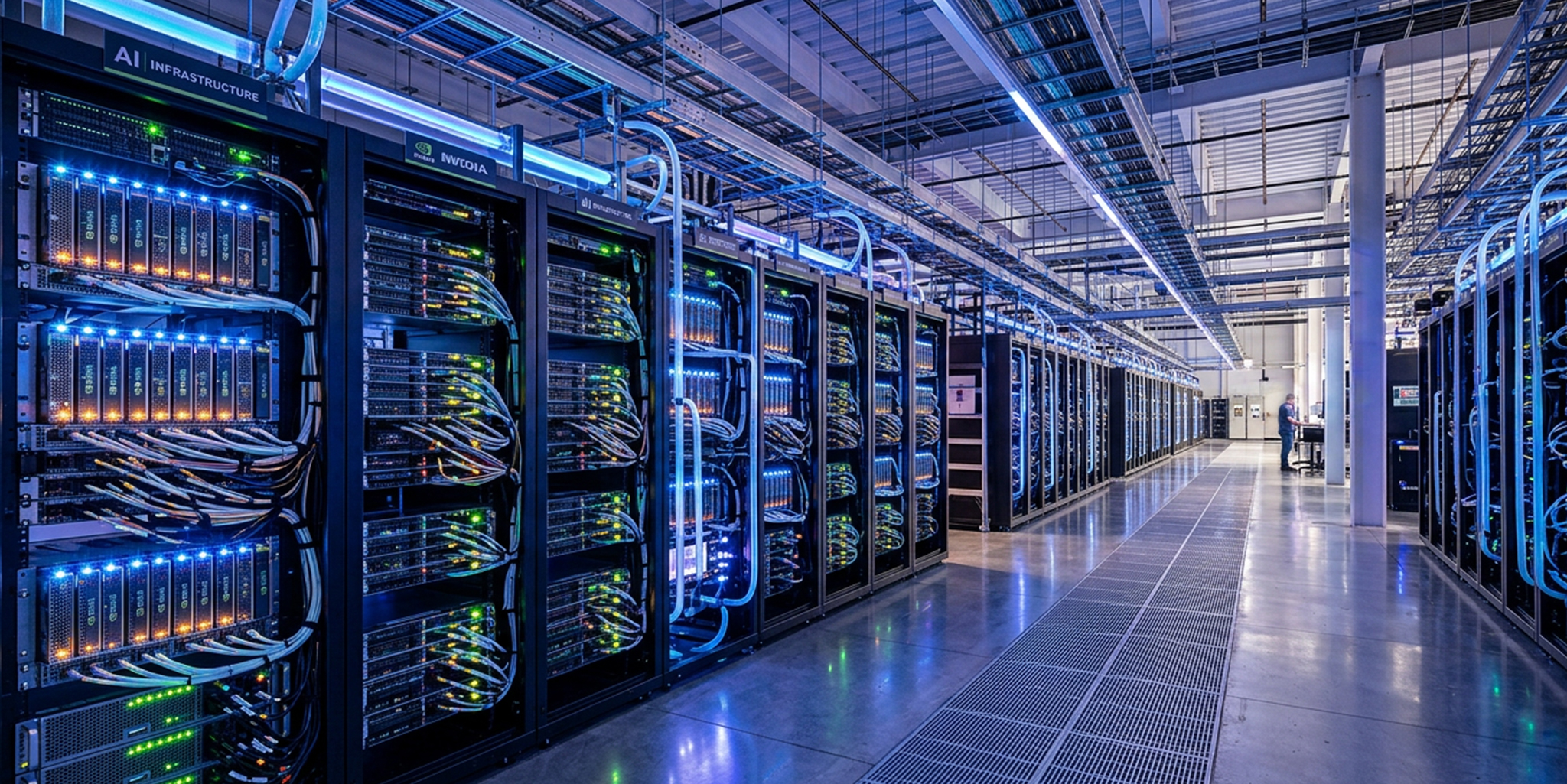
Artificial intelligence and data centres are now deeply connected. AI depends on large-scale compute, power, and network infrastructure, while data centres are increasingly using AI to manage operations, improve reliability, and control energy use at scale.
This relationship is reshaping how digital infrastructure is designed and delivered. As AI adoption grows, data centres are being pushed to handle higher loads, faster scaling, and more demanding performance requirements.
Designing Data Centres for AI Workloads
From CPU-Based Systems to High-Density Accelerators
Traditional data centres were designed around CPUs handling predictable workloads. AI introduces a very different operating model. Training and inferencing require parallel processing at scale, driving the adoption of GPUs, AI accelerators, and custom silicon.
This shift has a direct impact on infrastructure:
- Earlier GPU racks: 30–60 kW
- Current AI racks: 80–150 kW
- Next-generation designs: 200–400 kW per rack
- Emerging roadmaps: up to 500 kW to nearly 1 MW per rack
In addition to higher density, AI workloads create rapid spikes in power demand. Systems must respond instantly without compromising stability, making traditional infrastructure approaches inadequate.
Cooling Systems for AI: From Air to Liquid
Why Air Cooling Reaches Its Limits
Air cooling has supported data centres for decades, but its effectiveness drops as rack density increases. Beyond 30–40 kW per rack, it becomes difficult to maintain consistent airflow and temperature control.
- Cooling efficiency declines as heat loads increase
- Fan energy consumption rises sharply
- Hotspots become harder to manage
- Air distribution becomes uneven in dense environments
At higher densities, air cooling alone cannot keep systems within safe operating limits.
Liquid Cooling as a Core Design Requirement
Liquid cooling addresses these challenges by removing heat directly at the source, rather than cooling the surrounding air.
Two approaches are becoming standard:
Direct-to-chip liquid cooling
Cooling plates are attached directly to processors, allowing heat to be captured immediately and removed efficiently. This reduces heat buildup inside the data hall and improves overall thermal performance.
Two-phase liquid cooling
This method uses specialised fluids that absorb heat by changing state, allowing very high heat loads to be managed safely. It supports:
- Chips exceeding 1,000 watts
- Rack densities beyond 200 kW
Liquid cooling also reduces overall facility energy use by lowering the need for large air-handling systems.
Today, liquid cooling is not an add-on. It is a core requirement for AI-ready data centre design.
Power Systems Built for High-Density Operations
Rethinking Power Distribution
AI workloads demand stable, high-capacity power with no tolerance for interruption. To meet this, data centres are shifting to more flexible architectures.
Modular UPS systems are replacing large, central systems:
- Scalable in line with growth
- Easier to maintain
- Reduced downtime during upgrades
A key transition is the move to Medium Voltage (MV) UPS systems, operating at 6.6 kV, 11 kV, or higher. Instead of protecting small sections, these systems secure larger power blocks.
This results in:
- Lower transmission losses
- Fewer transformation stages
- Simplified redundancy design
These advantages are critical for large facilities exceeding 50 MW.
Battery Systems Supporting Reliability
Battery storage plays a central role in maintaining uptime.
- Lithium-ion batteries offer higher energy density and faster response times
- Distributed battery architectures improve fault isolation
- Maintenance can be carried out without shutting down large sections of the facility
This approach ensures continuity even under high and fluctuating loads.
Scaling Faster with Modular Data Centres
Meeting Demand with Speed and Flexibility
AI demand is growing faster than traditional construction timelines can support. To address this, operators are turning to prefabricated modular data centres (PFM).
These units are:
- Built and tested off-site
- Deployed up to 50% faster than conventional builds
Modern modular systems are designed specifically for AI and typically include:
- Liquid-cooled infrastructure
- High-density power systems
- Integrated monitoring platforms
Modular design allows organisations to expand capacity quickly and upgrade existing facilities with minimal disruption.
Using AI to Operate Data Centres More Efficiently
Real-Time Energy Optimisation
AI is improving how data centres manage energy. By analysing real-time sensor data, systems can:
- Adjust cooling setpoints automatically
- Identify and resolve thermal imbalances
- Reduce unnecessary energy use
Some facilities have achieved up to 20% reduction in cooling energy consumption through AI-driven controls.
Predictive Maintenance for Critical Systems
AI is also changing maintenance strategies. Machine learning models track equipment performance using data such as temperature, vibration, and electrical behaviour. This allows early detection of potential issues.
- Reduced unplanned downtime
- Lower repair costs
- Improved equipment life
Smarter Workload Allocation
AI enables dynamic workload placement based on:
- Power availability
- Temperature conditions
- Energy costs across locations
This improves utilisation and helps manage operational costs, particularly across large or multi-site environments.
Preparing for the Next Phase of Connectivity
Future data centres will also depend on advances in connectivity. While 5G expansion continues, research into 6G is already underway.
6G is expected to enable:
- Higher data transfer speeds
- Lower latency
- More responsive network control
This will strengthen integration between central data centres and edge systems, allowing faster data processing and movement.
Conclusion: A Structural Shift in Digital Infrastructure
AI and data centres are evolving together. Data centres must support higher densities, new cooling systems, and more resilient power infrastructure. At the same time, AI is making these facilities more efficient and easier to manage.
This is not an incremental change. It is a structural shift.
The next generation of infrastructure will be defined by its ability to scale quickly, handle high-density workloads, and operate with precision under constant demand.


