


Page 33 - TCE Annual Report 2024-2025
P. 33
Overview  Leadership Messages  Governance  Strategic Insights  Business Review  People & Community


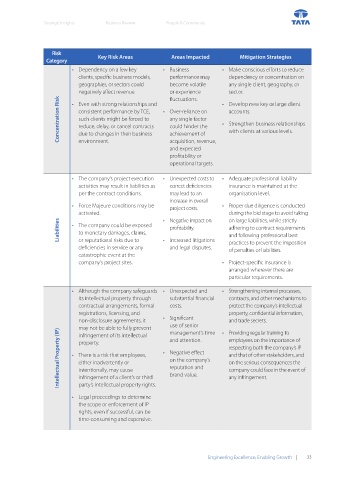
                   Risk            Key Risk Areas            Areas Impacted          Mitigation Strategies
                 Category
                          •  Dependency on a few key      •  Business          •  Make conscious efforts to reduce
                             clients, specific business models,   performance may   dependency or concentration on
                             geographies, or sectors could   become volatile     any single client, geography, or
                             negatively affect revenue.      or experience     •  Develop new key or large client
                                                                                 sector.
                      Concentration Risk  consistent performance by TCE,   •  Over-reliance on   •  Strengthen business relationships
                                                             fluctuations.
                          •  Even with strong relationships and
                                                                                 accounts.
                             such clients might be forced to
                                                             any single factor
                             reduce, delay, or cancel contracts
                                                             could hinder the
                                                                                 with clients at various levels.
                                                             achievement of
                             due to changes in their business
                                                             acquisition, revenue,
                             environment.
                                                             and expected
                                                             profitability or
                                                             operational targets.
                          •  The company’s project execution   •  Unexpected costs to   •  Adequate professional liability
                             activities may result in liabilities as   correct deficiencies   insurance is maintained at the
                             per the contract conditions.    may lead to an      organisation level.
                                                             increase in overall
                          •  Force Majeure conditions may be   project costs.  •  Proper due diligence is conducted
                             activated.                   •  Negative impact on   during the bid stage to avoid taking
                                                                                 on large liabilities, while strictly
                      Liabilities  •  The company could be exposed   profitability.  adhering to contract requirements
                             to monetary damages, claims,
                                                                                 and following professional best
                             or reputational risks due to
                                                             and legal disputes.
                             deficiencies in service or any   •  Increased litigations   practices to prevent the imposition
                                                                                 of penalties or liabilities.
                             catastrophic event at the
                             company’s project sites.                          •  Project-specific insurance is
                                                                                 arranged wherever there are
                                                                                 particular requirements.

                          •  Although the company safeguards  •  Unexpected and   •  Strengthening internal processes,
                             its intellectual property through   substantial financial   contracts, and other mechanisms to
                             contractual arrangements, formal   costs.           protect the company’s intellectual
                             registrations, licensing, and                       property, confidential information,
                             non-disclosure agreements, it   •  Significant      and trade secrets.
                             may not be able to fully prevent   use of senior   •  Providing regular training to
                      Intellectual Property (IP)  •  There is a risk that employees,   •  Negative effect   respecting both the company’s IP
                                                             management’s time
                             infringement of its intellectual
                                                                                 employees on the importance of
                                                             and attention.
                             property.
                                                                                 and that of other stakeholders, and
                                                             on the company’s
                                                                                 on the serious consequences the
                             either inadvertently or
                                                             reputation and
                             intentionally, may cause
                                                                                 company could face in the event of
                                                             brand value.
                             infringement of a client’s or third
                                                                                 any infringement.
                             party’s intellectual property rights.
                          •  Legal proceedings to determine
                             the scope or enforcement of IP
                             rights, even if successful, can be
                             time-consuming and expensive.


                                                                          Engineering Excellence, Enabling Growth    |   33

