


Page 29 - TCE Annual Report 2024-2025
P. 29
Overview  Leadership Messages  Governance  Strategic Insights  Business Review  People & Community


                Risk Management Organisation                     As TCE continues to grow and diversify across
                The risk function is led by the Chief Risk Officer   sectors such as infrastructure, oil and gas, metals
                (CRO), under the guidance of the Managing Director,   and mining, power, and digital services, the business
                Chief Operating Officer, and the Board. The CRO is   is increasingly exposed to evolving risks driven by
                supported by a Corporate Risk team and Business   changing government policies, rapid technological
                Unit Risk Officers (BUROs) across the organisation. This   advancements, and pressing climate related imperatives.
                collaborative structure ensures consistent deployment   Resilience planning has therefore become a strategic
                of risk frameworks and facilitates alignment of risk   priority. It is no longer viewed merely as a compliance
                management practices across Business Units. These   requirement but rather as a proactive approach to
                procedures also extend to functional and organisational   ensure long-term business continuity and value
                levels, ensuring that risks are assessed not only at the   creation. Building resilience involves the development
                                                                 of adaptive systems, flexible delivery models, diversified
                project level but across Business Units and supporting   supply chains, and agile governance structures that
                functions. The organisation’s Risk Management    enable the organisation to respond effectively to
                Framework is structured to provide a comprehensive,   sudden shocks and long-term disruptions. By integrating
                proactive and integrated approach to risk identification,   risk management into all strategic and operational
                analysis, mitigation and monitoring throughout the   decision-making processes, TCE aims to strengthen
                company’s operations.                            its ability to anticipate emerging threats, respond to
                                                                 challenges swiftly, and protect stakeholder interests. This
                Risk Outlook and Resilience Planning             approach not only helps ensure continuity of service but
                TCE operates on a global scale and faces a broad   also positions the company to take advantage of new
                spectrum of risks across its business landscape. In   opportunities in an ever-changing global landscape.
                the current environment marked by uncertainty and   The key areas of risk and corresponding mitigation
                global disruption, the risk outlook for engineering   strategies have been outlined in the table below. These
                consultancies has expanded significantly. It now   provide a comprehensive view of the risk landscape and
                includes not only traditional project and operational   the structured approach TCE has adopted to manage
                risks but also encompasses geopolitical instability,   and reduce the impact of such risks across its operations.
                regulatory uncertainty, cyber security threats, and
                challenges related to environmental, social, and
                governance (ESG) factors.


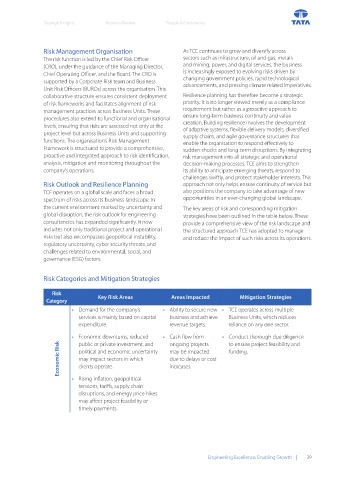
                Risk Categories and Mitigation Strategies


                   Risk            Key Risk Areas            Areas Impacted          Mitigation Strategies
                 Category
                          •  Demand for the company’s     •  Ability to secure new  •  TCE operates across multiple
                             services is mainly based on capital   business and achieve   Business Units, which reduces
                             expenditure.                    revenue targets.    reliance on any one sector.

                          •  Economic downturns, reduced   •  Cash flow from   •  Conduct thorough due diligence
                                                             ongoing projects
                                                                                 to ensure project feasibility and
                             public or private investment, and
                      Economic Risk  political and economic uncertainty   may be impacted   funding.
                                                             due to delays or cost
                             may impact sectors in which
                                                             increases.
                             clients operate.
                          •  Rising inflation, geopolitical
                             tensions, tariffs, supply chain
                             disruptions, and energy price hikes
                             may affect project feasibility or
                             timely payments.


                                                                          Engineering Excellence, Enabling Growth    |   29

