


Managing Pressure Surges in LPG Unloading Pipelines
Liquefied petroleum gas plays a vital role in energy supply across industrial, commercial and domestic sectors. The safe transfer of LPG from marine vessels to onshore storage facilities is therefore a critical engineering and safety responsibility. One of the most significant technical challenges in this process is managing pressure surges within unloading pipelines.
Pressure surges occur when there is a sudden change in fluid velocity, leading to a rapid rise or fall in pressure. During routine hydraulic design, pipelines are sized using steady state calculations that consider static head and friction losses. However, these calculations do not capture what happens during abnormal or upset conditions. Events such as pump trips, rapid valve closures or emergency shutdowns can generate transient pressures that exceed normal operating values.
In LPG unloading systems, where long pipelines connect ship pumps to storage tanks, such transient events can have serious consequences. If pressure surges are not properly analysed and controlled, they can compromise pipeline integrity, damage equipment and create hazardous operating conditions.
How pressure surges develop
Pressure surges are typically triggered by sudden disturbances in flow. These may include the shutdown or tripping of a pumping unit, unstable control behaviour, oscillating tank levels or the rapid closure of control or isolation valves. Any sudden obstruction in the flow path can initiate a pressure wave that travels through the pipeline.
When a valve closes rapidly or a pump trips, two pressure waves are generated. Upstream of the event, a high pressure wave develops as flow reduces sharply. Downstream, pressure drops and may fall below vapour pressure, creating the risk of cavitation. In LPG systems, this combination of high pressure and low pressure zones presents a serious safety concern.
If left unmanaged, repeated surge events can lead to fatigue damage, loss of containment or even catastrophic pipeline failure.
Why surge analysis is essential for LPG unloading
LPG ship unloading lines operate under complex conditions. They typically extend over long distances and include multiple components such as ship pumps, emergency release couplings, remotely operated valves and tank isolation valves. During emergency situations, several of these components may act simultaneously.
Surge analysis allows engineers to simulate these events before the system is commissioned. By modelling how pressure waves propagate through the pipeline, it becomes possible to identify the most severe operating scenarios and assess whether the pipeline can safely withstand them.
This analysis forms a critical part of safe design, ensuring that pipelines remain within allowable pressure limits under all credible operating conditions.
Objectives of the analysis
The surge and stress analysis of the LPG unloading pipeline was undertaken with four key objectives.
The first objective was to identify surge risks by assessing the likelihood and magnitude of transient pressure events and determining whether surge protection measures were required. The upper limit of the surge pressure is considered as 1.33 times rated pressure of pipe as per ASME B 31.3 clause 302.2.4.
The second objective was to validate the pipeline design by confirming that pipe size, wall thickness, material selection, routing and support configuration were suitable for the full range of transient pressures along the pipeline.
The third objective was to optimise valve operation by establishing appropriate opening and closing times that would minimise pressure surges without affecting operational safety.
The final objective was to provide reliable inputs for piping stress analysis, enabling the accurate design of piping system, pipe supports and associated structures.
System description and design basis
The analysis was carried out for LPG unloading pipelines handling propane, butane and propylene at an import terminal facility. The system consists of ship pumps connected to onshore storage tanks through unloading pipelines running from the jetty to the tank farm.
The unloading pipelines extend approximately 2 km and include pipe sizes of 14 inch and 16 inch. The piping material is ASTM A333 Grade 6, Schedule 40, selected to suit low temperature LPG service. The design pressure of the system is 35 kg per cm², with a hydrotest pressure of 52.5 kg per cm². Design temperature is minus 48 °C, with operating temperatures ranging from minus 44.9 °C to 40 °C and an upset temperature of 65 °C.
In accordance with ASME B31.3 Clause 302.2.4, the maximum allowable surge pressure was limited to 1.33 times the rated pressure of the pipeline
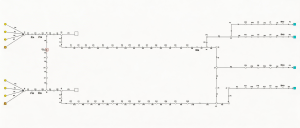
Graphic view of the AFT Impulse model showing the butane unloading pipeline network, ship pumps and storage tank connections.
Methodology for surge analysis
Surge analysis was performed using transient flow simulation software capable of modelling time dependent pressure, temperature and flow behaviour across the pipeline network.
The analysis was carried out in two stages. In the first stage, a steady state hydraulic model was developed to establish baseline flow rates and pressures under normal operating conditions. This model included pump performance characteristics, pipeline geometry and fluid properties.
In the second stage, transient simulations were performed to capture pressure variations during upset events. These simulations modelled how pressure waves developed and travelled through the pipeline following sudden changes in flow.
The system analysed included 8 ship pumps, with 2 standby pumps provided to meet flow requirements. Transient pressures were calculated at multiple locations along the pipeline to identify maximum and minimum pressure values.
Transient scenarios analysed
The surge analysis focused in detail on the butane unloading pipeline. The following operating scenarios were evaluated:
- Normal operating condition with all pumps running
- Closure of Powered Emergency Release Coupling valves
- Closure of individual remotely operated valves
- Closure of tank isolation valves
- Combined closure of all inline valves with simultaneous pump trip and emergency release coupling closure
These scenarios represent both routine operational actions and credible emergency events that the system may experience during its service life.
Key findings and mitigation measures
The analysis showed that certain rapid valve closures could generate significant pressure surges. However, it also demonstrated that these surges could be effectively controlled through operational measures.
One of the most effective mitigation measures identified was adjusting valve closure timing. By increasing closure times, the rate of change of flow was reduced, resulting in lower surge pressures.
For example, increasing the closure time of specific isolation valves from 8 s to 20 s significantly reduced peak transient pressures. Under the most severe scenarios, the peak transient pressure of 22.86 bar gauge was reduced to 11.17 bar gauge by optimising valve timing. The minimum transient pressure observed was 3.771 bar gauge.
In several cases, no additional surge protection devices such as relief valves or surge tanks were required once valve timings were optimised.
Interface with piping stress analysis
The results of surge analysis were directly used as inputs for piping stress analysis using Caesar II program. Transient pressure events generate thrust forces at bends, tees and other fittings, which must be considered when designing pipe supports.
A complete pipeline stress model was developed using industry standard software. Maximum thrust forces obtained from surge analysis were applied at the corresponding locations in the stress model using an equivalent static approach.
This approach is appropriate because the pipeline has sufficient response time for dynamic loads to stabilise. All load combinations, including static and transient loads, were checked for compliance with ASME B31.3. All the allowable limits of stresses, loads, displacements, sags etc are considered as per ASME 31.3 / 31.1 codes.
To address the presence of two-phase flow, a dynamic modal analysis was also performed. The minimum natural frequency of the piping system was confirmed to be above 4.5 Hz, indicating that the system is adequately rigid and not prone to excessive vibration.
Conclusion
Surge and stress analysis is a fundamental part of designing safe LPG unloading pipelines. It provides a clear understanding of how pipelines behave under abnormal operating conditions and ensures that transient pressures remain within acceptable limits.
The study demonstrates that careful modelling, combined with practical operational measures such as optimised valve closure times, can significantly reduce surge pressures without the need for complex additional equipment.
By integrating surge analysis with piping stress and modal analysis, engineers can develop unloading systems that are robust, code compliant and resilient under both normal and emergency conditions. This integrated approach is essential for protecting people, assets and the environment in high consequence LPG transfer operations.


